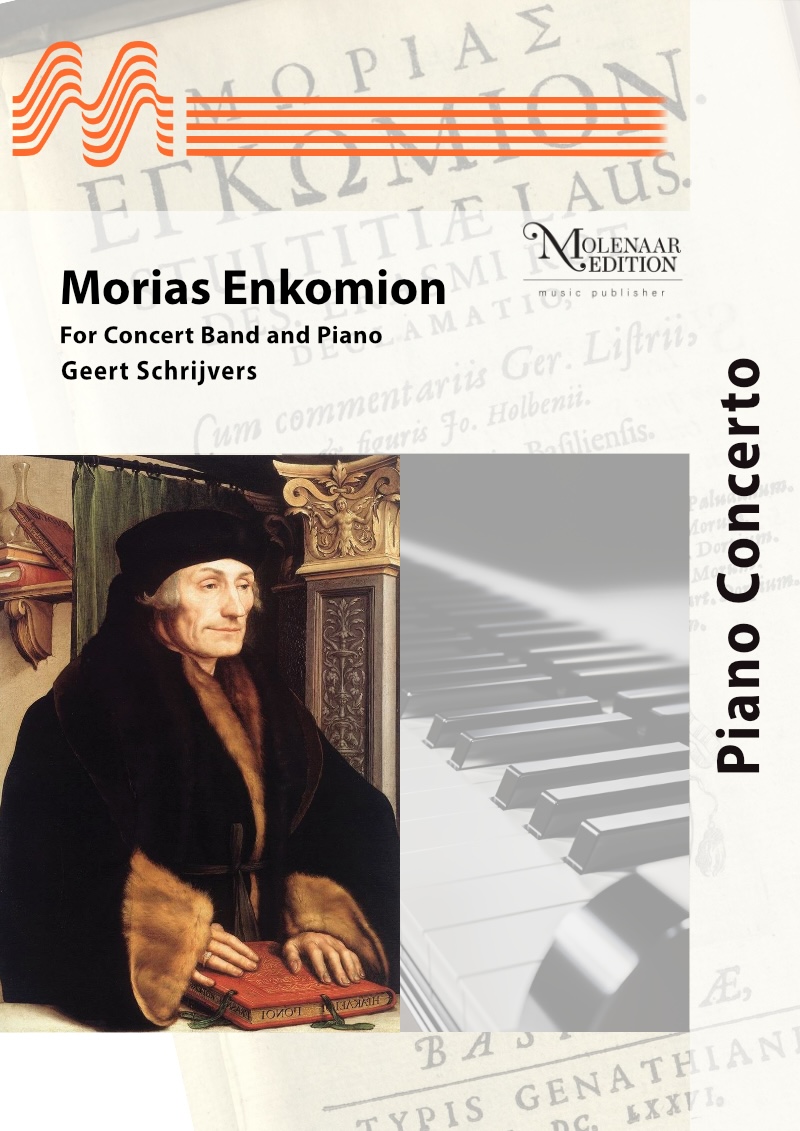
Morias Enkomion
Piano Concert
The composition Morias Enkomion is inspired by the book of the same title by the medieval humanist Desiderius Erasmus, better known in Dutch as The Praise of Folly. In this work, the goddess Folly delivers a eulogy in her own honor, presenting her qualities as virtues. Erasmus figuratively dons the fool’s cap in order to offer sharp criticism of circles he knew from within: theologians, clergy, princes, and politicians. From his position as an outsider, he proved to be a keen and independent observer.
In Morias Enkomion, this observing role is assigned to the piano—an instrument that does not normally belong to the standard instrumentation of a wind orchestra and is therefore ideally suited to react to, provoke, and anticipate the sounds produced by the ensemble. In the guise of the goddess Folly, the piano can contemplate, criticize, and mock its surroundings.
Alongside Erasmus’ book, the broader social climate surrounding the COVID‑19 pandemic also served as a source of reflection and inspiration. Terms such as anti-vaxxers, conspiracy theories, lockdowns, and booster shots were deployed in a disturbing kind of trench warfare, in which the most vulnerable points of society were exposed and polarization became ever more pronounced. As in Erasmus’ book, in Morias Enkomion it is Folly—embodied by the piano—who speaks. She describes the bizarre situation in which we find ourselves.
Within the orchestra, we hear a blustering politician with outlandish ideas, portrayed by the bass trombone. We also hear a sarabande-like melody that feels vaguely familiar, yet constantly changes its shape. This represents the alienation from people we once respected and loved, but no longer recognize due to radicalizing ideologies. The advance of polarization and the fear of escalation are expressed through a military march that, at an increasingly rapid tempo, becomes ever more difficult to control.
All these elements are observed, described, mocked, and lamented by the piano, which tries to hold its ground among them and make itself heard. At times it seems to shake its head in disgust, sorrow, or disbelief, causing the bells on its fool’s cap to jingle. The short “sleep‑out” motif that returns in various guises reminds us that mild mockery can sometimes be necessary to lead us toward introspection and insight.
| Composer |
| Geert Schrijvers |
| Arranger |
| Series |
| 21 |
| Instrumentation |
| 1 Full Score A3 - 1 Full Score - 1 Piano - 1 Piccolo - 2 Flute I - 2 Flute II - 1 Oboe I - 1 Oboe II - 1 English Horn - 1 Bassoon I - 1 Bassoon II - 1 Contra Bassoon - 1 Clarinet Eb - 4 Clarinet I - 4 Clarinet II - 4 Clarinet III - 1 Alto Clarinet Eb - 1 Bass Clarinet - 1 Contrabass Clarinet - 1 Soprano Saxophone - 2 Alto Saxophone I - 2 Alto Saxophone II - 2 Tenor Saxophone - 1 Baritone Saxophone - 2 Trumpet I - 2 Trumpet II - 2 Trumpet III - 2 Horn I + II Eb - 2 Horn I + II F - 2 Horn III + IV Eb - 2 Horn III + IV F - 2 Trombone I C - 1 Trombone I Bb (TC) - 1 Trombone I Bb (BC) - 2 Trombone II C - 1 Trombone II Bb (TC) - 1 Trombone II Bb (BC) - 1 Trombone III Bb (TC) - 1 Trombone III Bb (BC) - 1 Trombone Bass C - 2 Baritone I C - 2 Baritone I Bb (BC) - 2 Baritone I Bb (TC) - 2 Baritone II C - 2 Baritone II Bb (BC) - 2 Baritone II Bb (TC) - 2 Bas Bb (TC) - 2 Bas Bb (BC) - 2 Bas Eb (TC) - 2 Bas Eb (BC) - 4 Tuba C - 1 Snare Drum - 1 Bass Drum - 1 Mallets 1 - 1 Mallets 2 - 1 Timpani - 1 Cymbals - 1 Double Bass |
| Theme |
| Solo and Band |
| Complete set: | 170.00 |  |
| Score: | 34 | |
| Article number: | 013833090 | |
| Level: | 5 | |
| Duration: | 720 | |
| Available: | yes |
| Share | mail , facebook, twitter |
| View | |
| Youtube | Youtube |